

We develop a smart data methodology to
accelerate breeding for resilience.
Our mission is to develop resilient crops through data-driven design. To do so, we combine biological experimentation and large datasets with advanced computational modelling and artificial intelligence, reshaping how breeders improve crops. We create ‘smart data building blocks’ that enable breeders to develop new varieties more quickly and bring them to market sooner.
Our approach

Learning from thousands
of Arabidopsis plants
In our laboratories, we work with Arabidopsis Thaliana. Using existing data, we first develop hypothesis-driven models that guide targeted experiments. These studies generate large datasets showing how resilience emerges under stress, which we integrate into models outlining Arabidopsis’ key resilience traits.

Turning experimental data
into models
Based on this outline, we use AI and Mechanistic Modelling, to combine the experimental data into models that yield new insights into the key regulators of plant resilience.

Translation from model plant
to food crop
By starting from an understanding of underlying mechanisms rather than purely statistical patterns, we can adapt our models to other crops using far less crop-specific data. Instead of rebuilding knowledge for each species, we recalibrate existing models to reflect crop-specific traits.
The Smart Data Methodology
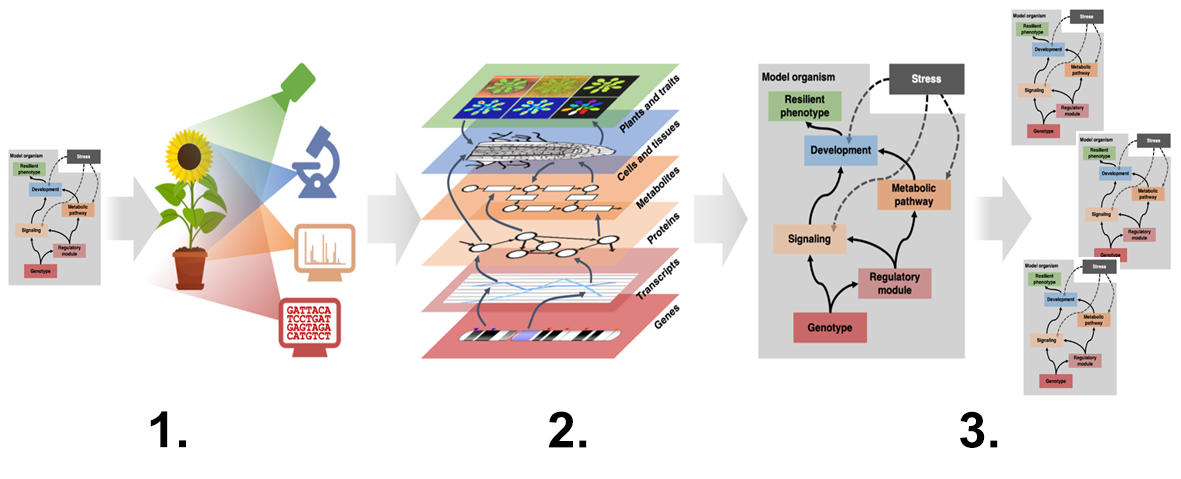
From data to knowledge
Smart data from hypothesis-driven experiments (1) are analysed using bioinformatics and artificial intelligence, then integrated into mechanistic models (2)— mathematical representations of how biological processes work — that reveal new insights and key regulators of plant resilience in a “systems biology 2.0” approach. These insights are subsequently applied to other crop species (3).
Modelling Arabidopsis
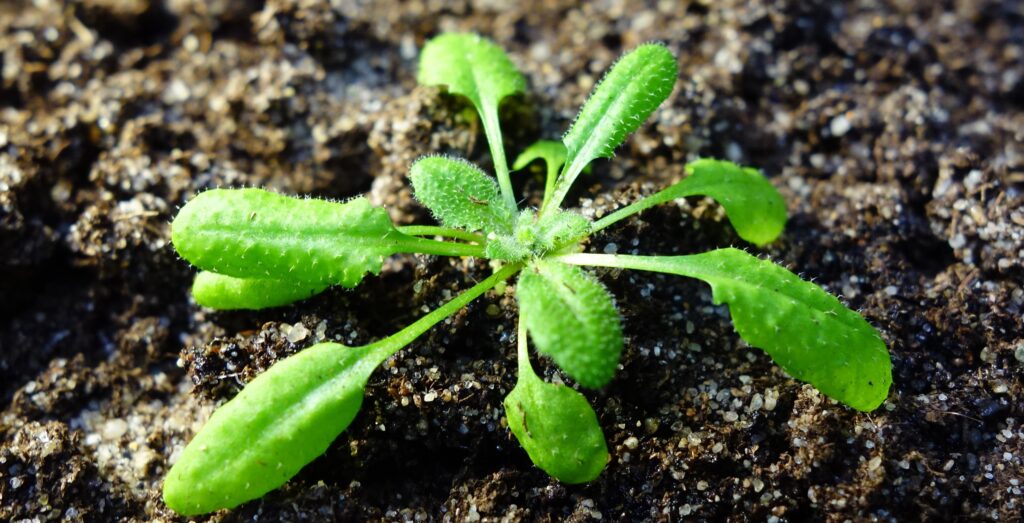
We expect to be able to model Arabidopsis in the next couple of years, leading to a more refined model after approximately five years. Subsequently, these models can be translated to specific crops.
When this phase arrives, significantly less crop-specific data will be needed. This will enable adaptation to so-called ‘spin-off’ models for other crops. Breeders can then use these models to step up their game.